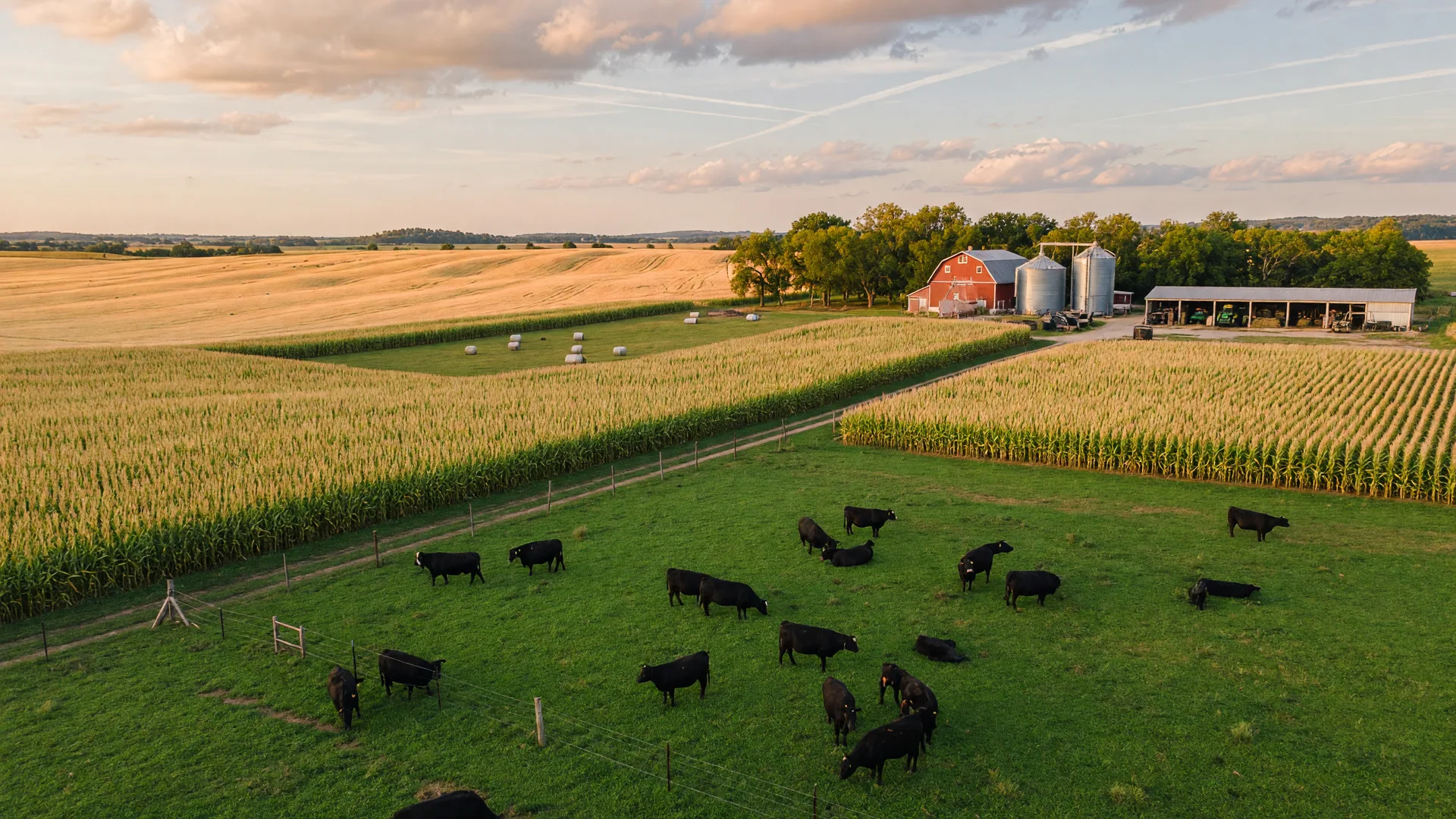
This is the first Farm Gal Market Update. Every week or two I will pull together what happened in the commodity markets that matter most to Wisconsin farmers and landowners. Cattle, corn, soybeans, and wheat. Not Wall Street analysis. Just what moved, why it moved, and what it means for the folks who own the ground and the livestock.
Let us start with the week that was. August 20, 2026, was a day of mixed signals across the four major ag markets. Grains rallied on crop tour data and Black Sea disruption, while cattle continued to digest the shock of major packing plant closures. Here is the breakdown.
Cattle
Live cattle Oct contract: $2.17625/lb (217.625¢/lb), up 0.4¢
What Happened
Live cattle futures inched up 0.4¢ on Thursday to close at $2.17625 per pound. That is a modest recovery from the beating the market took the week prior, when September feeder cattle dropped $10.68 to $334.55 per hundredweight and live cattle contracts fell $1.52 to $4.35 across the board.
The driver then was Tyson Foods. On August 13, Tyson announced the immediate closure of its Joslin, Illinois beef packing plant (3,000 head per day capacity), the sale of its Pasco, Washington plant (2,000 head per day), and the shuttering of its case-ready facility in Eagle Mountain, Utah. The market reacted hard and fast. Fewer packing plants mean fewer places to sell cattle, and that pressure showed up in the futures board immediately.
Cash trade through mid-August ran around $228 to $230 in the North, which is off the highs but still historically strong. The underlying story has not changed. The U.S. beef cow herd is at a 75-year low. Drought conditions still cover over 75% of the beef cow herd across the Great Plains. Cull cows are going to town because there is no grass, and that adds short-term supply while making the long-term supply picture even tighter.
Drovers ran a piece on August 13 looking at packing plant capacity. The takeaway: average fed cattle plant utilization sits around 78%, and cow slaughter capacity runs just 55-60%. The industry is restructuring around high-efficiency plants at a time when there are not enough cattle to fill the ones we already have. That tension is not going away.
Next 48 Hours Outlook
USDA is scheduled to reopen the Douglas, Arizona port of entry for Mexican cattle imports on August 24. That is a closely watched event. More feeder cattle from Mexico could ease some of the supply tightness in the near term. Cash trade will be the main number to watch. If packers start bidding below $225, expect another leg lower in futures. If cash holds, the market should find a floor near current levels. The wider analyst view, including from Scott Shellady on RFD-TV, leans bearish on the near term as the market digests the plant closure news, but nobody is calling for a collapse given how tight the herd is.
Corn
Sep contract: $4.80/bu, up 7¢. Dec contract above $5.00/bu
What Happened
Corn was up 7¢ on the day, with the September contract closing at $4.80 per bushel and the December contract pushing back above $5.00. The rally was fueled by three things: the Pro Farmer Crop Tour, the August WASDE report, and strong export demand.
The Crop Tour has been the main story all week. Day 3 results on August 19 from Illinois showed corn yield estimated at 184.19 bushels per acre, down 7.7% from the 2025 Tour and the lowest kernel counts around average since 2013. Day 2 showed Indiana at 183.5 bushels per acre, down 5.3% from last year. Nebraska was down 8.9%. South Dakota down around 14%. Those numbers matter because they tell you the crop is not as good as the trade thought it was a month ago.
The August 12 WASDE report set the tone for this rally. USDA lowered the national corn yield to 180.7 bushels per acre from 183 in July. That is below pre-report trade estimates, and it tightened ending stocks below 1.9 billion bushels.
Export demand has also been firm. China continues to buy U.S. corn, and the global supply picture is getting tighter with the Black Sea situation disrupting Ukrainian grain flows. Weather across the Midwest through late August is unthreatening. Temperatures are staying below 90 degrees across most of the Corn Belt, which is ideal for the grain-fill stage. Some pockets are still too wet from the flooding earlier in August, and some northern areas are still dry, but overall the crop is finishing in decent condition.
Next 48 Hours Outlook
The final Pro Farmer Crop Tour results from Iowa and Minnesota land on the night of August 20. Those numbers will set the tone for Friday's trade. If Iowa shows significant yield reduction, corn can push higher. If the tour numbers come in better than expected, expect a pullback. Managed-money speculators have been adding net long positions since the WASDE report, so there is some momentum behind the rally. Watch the export sales report Friday morning for the latest China buying activity.
Soybeans
Sep contract: $12.2175/bu (1221-6), down 0.4¢. Nov near $12.50
What Happened
Soybeans were essentially flat on the day, down 0.4¢, but the November contract is trading near $12.50, which is a strong level. The soybean story is more about demand than supply right now.
The Pro Farmer Crop Tour showed mixed pod counts. Illinois came in at 1,430.77 pods in a 3x3 square, down 3.3% from 2025 but up 2.9% from the three-year average. Scouts in Illinois noted soybean potential was the bright spot, with adequate moisture and good pod counts. Western Iowa showed pod counts slightly below last year but still above the three-year average. Disease was noted building in some soybean fields, but nobody is panicking yet.
The demand side is where the real action is. China has purchased roughly 80% of new-crop U.S. soybean export sales in early August. A Sinograin auction cleared 85% of offered reserves. That is a lot of beans moving to one destination, and it is keeping a firm bid under the market. WASDE lowered the soybean yield to 52.7 bushels per acre from 53 in July, which was below trade expectations and supportive for prices.
Next 48 Hours Outlook
Like corn, the final Crop Tour numbers from Iowa and Minnesota will be the main event. Pod counts in the western Corn Belt will tell us whether the soybean crop has the yield potential the trade was expecting at the start of August. Chinese buying will remain a critical support factor. Any signs of a slowdown in export inspections or new sales could take a couple cents off the board. Weather stays favorable for pod fill through the weekend.
Wheat
Sep contract: $6.8825/bu (688-2), up 8¢
What Happened
Wheat was the biggest mover of the day, up 8¢ to close at $6.8825 per bushel. The rally was not about U.S. production. It was about the Black Sea, and the situation there is getting serious.
Ukraine's farm minister announced that the country would export only 1.5 million metric tons of grain in August. That is well below the prior estimate of 5 million. Grain exports during the first two weeks of August fell 75% year over year. The Kerch Strait, a critical shipping chokepoint for Russia's Azov export corridor, is under pressure. Analysts are warning that logistical issues could prevent 5 to 10 million tons of wheat from moving through the strait.
Russia has also been attacking rail and bridge networks connecting Ukraine to its Danube River ports. Both sides are hitting commercial shipping in the Black Sea. The USDA lowered its outlook for Russian and Ukrainian grain exports in the August WASDE report, and that revision is now playing out in real time.
On top of the Black Sea situation, the European wheat harvest was hit hard by drought earlier this summer. France and Germany both saw yields drop. The European wheat crop is forecast well below 2025 levels, which means less competition for U.S. wheat on the global market. U.S. hard red winter wheat futures have been hovering near a three-year high of $7.77 per bushel.
Next 48 Hours Outlook
Wheat feels like it has more upside than downside in the short term. The Black Sea export disruptions are not going to resolve in 48 hours, and every day they continue, more global buyers shift their attention to U.S. wheat. The weekly export sales report Friday morning will show whether that shift is happening. If we see strong U.S. wheat sales, look for CBOT wheat to test the $7.00 mark. If the Black Sea situation de-escalates, expect a sharp pullback. That is the nature of wheat right now. Every headline out of the Black Sea moves the board.
What This Means for
The Bottom Line
Cattle is sorting out the Tyson closures but the long-term tight supply story is intact. Corn and soybeans are getting support from Crop Tour findings and strong export demand. Wheat is rallying on Black Sea disruption that shows no sign of easing. If you own farm or land in Wisconsin, these markets matter to your property value, and right now the signals are mostly favorable for sellers.
I follow these markets because they tell me what the buyers I work with are thinking. If you want to talk about what your farm or land is worth in this market, give me a call. I will walk your ground with you and give you an honest read on where things stand.
Read More on the Site
This update lives under our Cattle and Cash Crops section, where you can find deeper guides on cattle property, crop land, and what Wisconsin rural land is really worth.