Farm Gal Land Knowledge
Cattle and
Cash Crops
A look at livestock and row-crop farming across Wisconsin's rural landscape
Livestock and Land
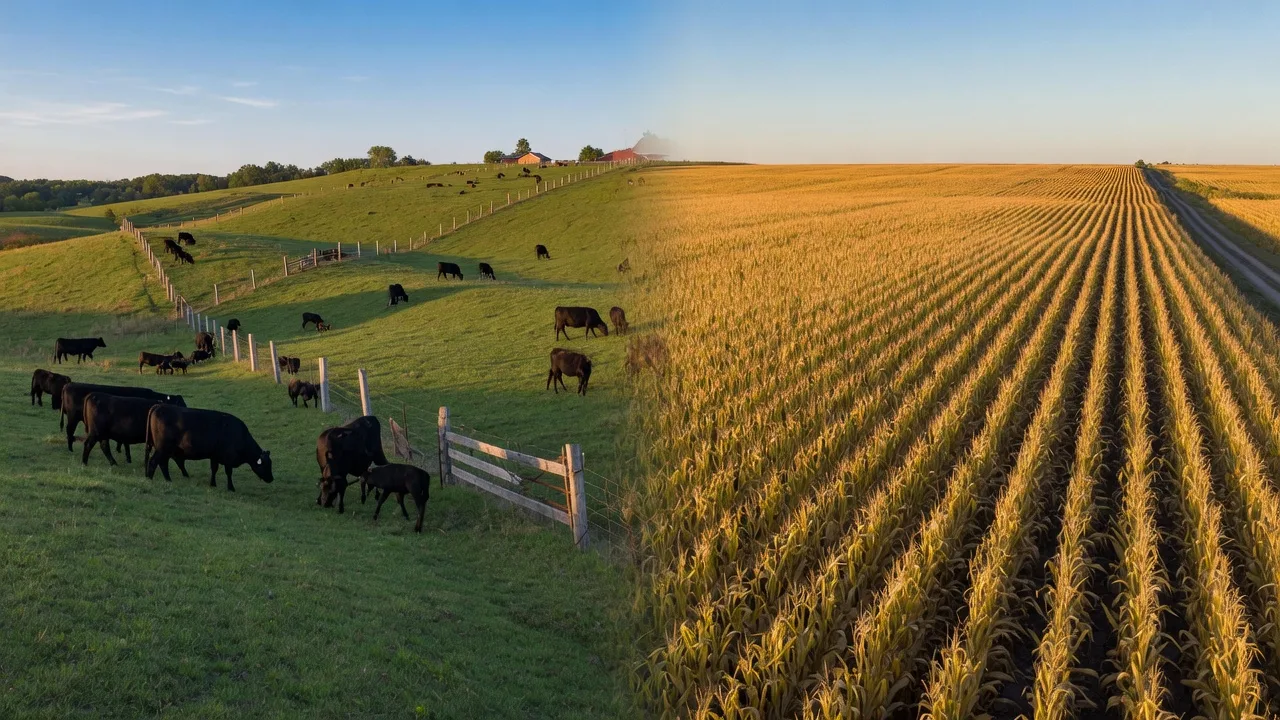
Wisconsin has long been known for its dairy heritage, but the state's cattle industry goes well beyond the milk barn. Beef cattle operations, especially black angus herds, are a significant part of the rural landscape across southern and central Wisconsin. From the rolling pastures of Walworth County to the crop-rich bottomlands along the Wisconsin River, this is prime cattle and cash crop country.
Cash crops like corn, soybeans, and hay form the backbone of Wisconsin's agricultural economy. Corn alone is grown on millions of acres statewide, feeding both the livestock industry and the state's growing ethanol and grain markets. Soybeans are a major cash crop too, and hay production supports the dairy and beef operations that dot the countryside. These crops do more than earn income. They support livestock operations by providing feed, bedding, and rotational grazing options that keep cattle healthy and land productive.
Wisconsin has over 35,000 cattle farms and ranks among the top states for beef production in the Midwest. That means the market for well-managed cattle properties with good crop ground is steady. When you know how to read the land, you can spot the difference between a property that just has cows and one that is built for real production.
What I Know
as a Farm Gal
I am not a city agent who read a book about farms. I worked side by side with my husband at our family grain elevator in Walworth County before we successfully sold it. I know what it means when a farmer says a field has good drainage or when a cattleman walks a pasture and points out where the water tanks need to sit.
I currently own beef cattle with my family. That means I know the difference between good handling facilities and bad ones. I know that a barn built for dairy is not the same as one built for beef. I know how important water access is and how a pond or a creek can make or break a grazing rotation.
When I look at a cattle property, I look at water first. Then fencing. Then pasture quality and the condition of the barns and handling facilities. For cash crop land, I look at soil quality, drainage, road access for equipment, and whether there is grain storage on site. Those details matter to every serious buyer I work with.
Cattle Property Checklist
Water access and reliability
Pasture quality and grass stands
Fencing condition and layout
Barns and handling facilities
Access for equipment and hauling
Crop Land Checklist
Soil quality and type
Drainage and tile systems
Road access for equipment
Grain bins and storage capacity
Field shape and size for modern equipment
What Buyers Look For
Buyers of cattle and crop properties come in with a clear idea of what they need. Here is what I hear most often.
Fenced Pastures
Good grass stands and well-maintained fencing are the first thing cattle buyers check. Cross-fencing adds value for rotational grazing.
Reliable Water
Wells, ponds, streams, or rural water hookups. Buyers want to know the water source is dependable year-round, especially in drought months.
Barns & Facilities
A good set of barns, a working chute, and handling pens save a buyer thousands. These structures are a major part of the property's value.
Tillable Acres
Corn, soybean, and hay ground that is ready to farm gives a property immediate income potential. Soil quality and drainage are key.
Grain Storage
Grain bins and on-site storage add serious value. They let the operator hold grain for better prices and reduce hauling costs.
Road Access
Good road frontage and farm-lane access for hauling equipment, livestock trailers, and grain trucks matter more than most sellers realize.
Soil & Drainage
Tile drainage, soil type maps, and yield history tell buyers what the land can produce. Good dirt commands a premium every time.
Proximity to Markets
Feed suppliers, livestock auctions, grain elevators, and veterinary services within a reasonable drive make a property more practical and attractive.
What Sellers
Should Highlight
If you are selling a cattle or crop property, you have more to work with than you think. The key is knowing what to emphasize in your listing and what buyers actually want to see.
Start with the numbers that matter. Herd capacity tells a buyer how many head the pasture can carry. Crop yield history on the tillable acres gives confidence about the land's productivity. Infrastructure like fencing, barns, grain bins, and handling facilities all translate to dollars a buyer does not have to spend.
Water is non-negotiable. Document every water source on the property and its condition. A well log, pond depth, or stream access record goes a long way. Fencing is the same story. Good perimeter and cross-fencing saves a cattle buyer months of work.
If you have Conservation Reserve Program (CRP) land on the property, document it. CRP ground has real value for both conservation-minded buyers and as a dependable income stream. Acreage, payment rates, and contract length all matter.
What to Prepare for Sellers
Herd Capacity Records
Document how many head the pasture has historically supported
Soil Maps & Yield History
Soil type maps, tile maps, and yield records for tillable acres
Water Source Documentation
Well logs, pond surveys, rural water hookup records
Fencing & Infrastructure Notes
Fence type, condition, age, and total linear feet of fencing
CRP Documentation
CRP acreage, payment rates, contract terms and expiration
Grain Storage Details
Bin capacity, condition, and any drying or handling equipment
Wisconsin Cattle
Wisconsin agriculture runs deep. Here are some of the numbers that tell the story of cattle and crops in the Badger State.
Cattle Farms in Wisconsin
Wisconsin has more cattle farms than almost any other state, with the majority operating as family-owned beef and dairy operations.
Acres of Corn
Wisconsin farmers plant millions of acres of corn annually for grain, silage, and livestock feed across the state.
Beef Production Rank
Wisconsin ranks among the top 15 states for beef cattle production in the U.S., with over a million head of beef cows.
Soybean Acres
Soybeans are the second-largest row crop in Wisconsin, with around 1.6 million acres planted each year.
Dairy State
Wisconsin is the second-largest dairy state in the U.S., and the cattle and crop industries are deeply connected to that heritage.
Top Crop County
Walworth County in southern Wisconsin is one of the state's leading agricultural counties, known for both cattle and cash crop production.
Farm Gal
Straight-talking commodity market coverage for Wisconsin farmers and landowners. Cattle, corn, soybeans, and wheat every week or two.
September 24, 2026
Cattle rally back on the tight supply story with October live up $2.15, corn and soybeans ease into the Trump-Xi summit, and wheat touches a four-week low on Black Sea ceasefire talk.
September 21, 2026
Cattle rally on a record-low August placement total in the Cattle on Feed report, grains rebound on positive US-China trade talk, and a drier window opens for harvest.
September 17, 2026
Cattle back off into Friday's Cattle on Feed report, corn eases on harvest pressure at $5.34, while soybeans firm on harvest-delay risk and wheat gains on late fund buying.
September 14, 2026
Friday's WASDE was a sell-the-news day: soybeans fell 35 3/4 cents on a surprise yield increase, corn gave back a midday pop to $5.30, and wheat slipped on higher world stocks, while cattle rallied into Monday on cheaper corn.
September 10, 2026
Grains fade into the September WASDE with corn at a ten-day low, beans fading toward $13.00, and wheat giving back its Black Sea premium on peace-talk talk. Cattle trade mixed with feeders firm.
September 7, 2026
Grains fade into the Labor Day weekend on profit-taking off contract and multi-year highs. Corn near $5.37, beans above $13, wheat gives back Black Sea premium. Cattle consolidates oversold.
September 3, 2026
Grains make fresh highs then fade on profit-taking into the September WASDE. Corn near $5.43, beans above $13.00, wheat holding a Black Sea premium. Cattle drifts on thin cash.
August 31, 2026
Wheat caps its biggest weekly gain in years on Black Sea fear. Corn at a three-year high. Soybeans ride Chinese demand. Cattle fades on thin cash.
August 27, 2026
Wheat limit-up on Black Sea crisis. Corn above $5. Soybeans surge on Chinese demand. Cattle under pressure.
August 20, 2026
First edition. Cattle digesting Tyson plant closures. Grains rally on Crop Tour data and Black Sea disruption.