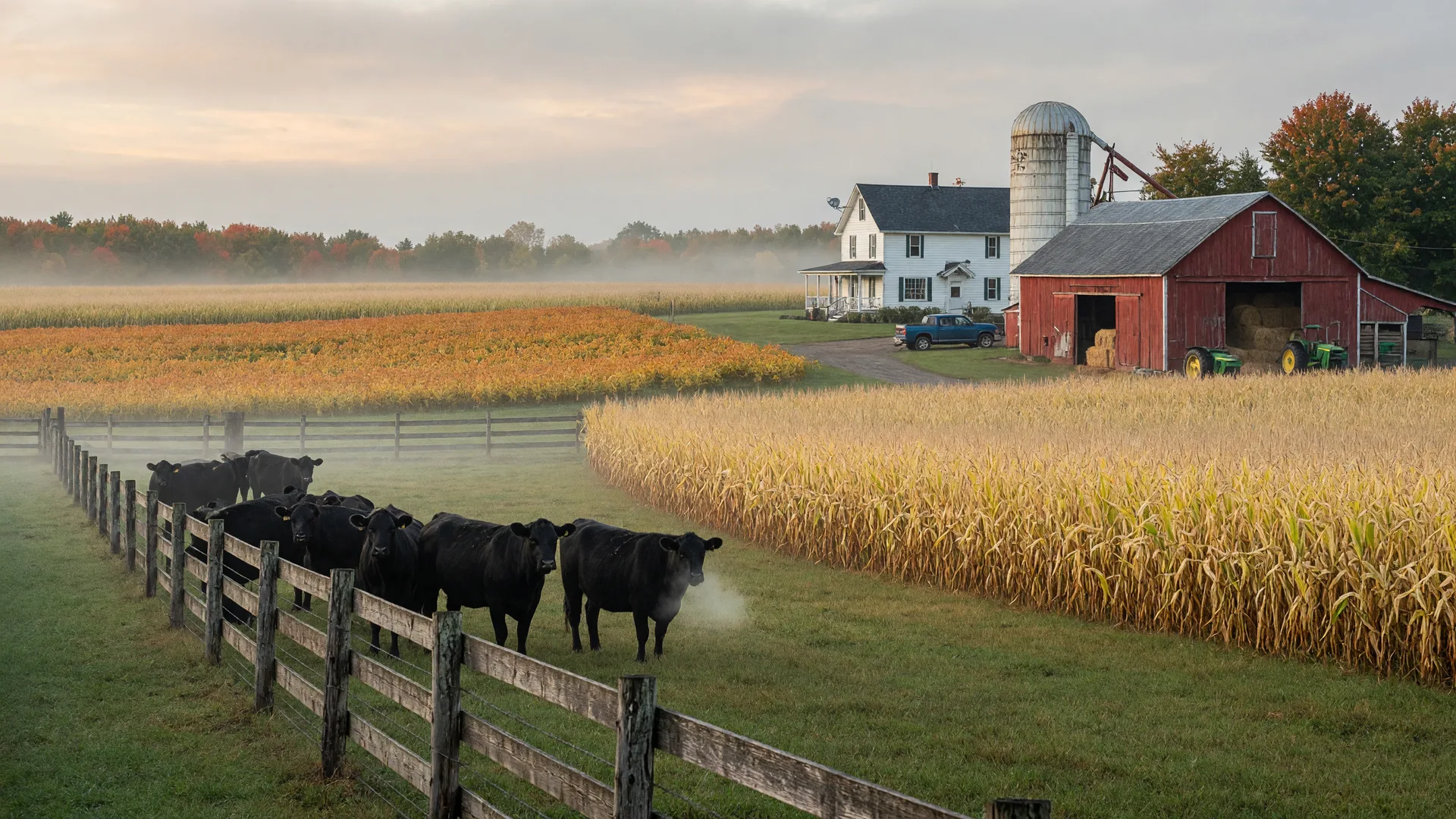
Wednesday was a pullback day across the grain complex with the September WASDE now 48 hours out, and cattle traded mixed with feeders holding their own. December corn slid to its lowest close in ten days, November soybeans faded again on profit-taking, and wheat kept giving back its Black Sea premium as talk of peace talks resurfaced. Live cattle closed lower on short covering while feeder cattle bucked the trend and finished higher. Here is the straight talk on Wednesday's close and the look ahead over the next 48 hours into the big report Friday.
Cattle
Wed Sep 9 close: Oct live cattle $215.85/cwt, down $1.17. Oct feeder $325.82/cwt, up 37 cents
What Happened
CME cattle futures finished mixed Wednesday on short covering. October live cattle settled down $1.17 at $215.85 per hundredweight and December gave back 75 cents to $218.47. Feeder cattle were the exception: October feeders settled around $325.82, up about 37 cents, and the spot September contract settled up 83 cents at $329.70. Traders read the feeder strength as a follow through on what has been strong work through the summer, and as a bullish signal that buyers are still paying up for weaned, quality calves into fall pasture turnover.
The cash market had not established a price yet as of Wednesday. Show lists were down in all areas, box prices had improved, and Southern asking prices were running around $225 live. Feedlots were holding their asks firm, hoping cash would finally follow the futures higher. Boxed beef was mixed: the Choice cutout added $3.20 to $380.77 per hundredweight while Select slipped $3.05 to $352.34. Estimated federally inspected slaughter came in near 109,000 head for the day, about 9,000 head above last week.
One driver creeping into the cattle conversation is energy. October WTI crude settled up $2.77 at $95.95 with record diesel prices amid the Iran conflict, and higher fuel costs hit packer margins, hauling, and feedlot break-evens all at once. Market analysts like Hales are watching the setup and note that strong cash could pull futures back up. The long-term tight-herd story remains intact; this is a market grinding sideways and waiting for cash to set the next direction.
Next 48 Hours Outlook
The next two sessions are a cash-market waiting game. Packers have yet to set a price, and if the show lists stay thin and boxed beef firms, live cattle futures have room to work back toward the highs. Watch whether boxes start asking in the low $220s; a trade there would read as confirmation, not hope. The WASDE Friday is a grain event first, but a bearish grain read takes pressure off feeding costs and gives the feeder complex extra air. Keep an eye on energy too: while crude stays bid, margins stay squeezed and that caps how far packers can chase cash.
Corn
Wed Sep 9 close: Dec contract $5.27 3/4/bu, down 5 3/4 cents, lowest close in ten days
What Happened
December corn settled Wednesday at $5.27 3/4 per bushel, down 5 3/4 cents, its fifth straight losing session and the lowest close in ten days. The market has cooled from the contract and three-year highs marked in late August, with the roughly 90-cent rally that built through the summer fading into position squaring and early-harvest pressure, and a lack of fresh bullish headlines after the big run. Early harvest is picking up in the drier southwestern Corn Belt, and corn moisture is coming down fast enough that hedge pressure is starting to show up.
What makes this fade notable is who is holding the other side. Managed money came into this week with a record net-bullish corn position, and Advance Trading flagged through Brownfield that the September WASDE is historically a volatile report, with corn commonly moving 10 to 15 cents in either direction. The trade assumption going in is corn use near 16.33 billion bushels with roughly 1.42 billion bushels of carryout, which leaves the market thin and report-sensitive either way.
Next 48 Hours Outlook
Corn is now all about Friday's WASDE. The market has discounted a tightening supply story for weeks, and if USDA confirms a crop cut the longs are positioned for a rebound back toward the $5.50 area. If the report disappoints, a record-long managed money position gives the market a lot of room to correct toward the $5.20s support. Weather stays the wildcard: the crop in the field still needs to finish, and hot, dry stretches across the western Corn Belt keep a premium alive right up through the report. The weekly export sales numbers Thursday matter too, and a strong print keeps the demand story honest.
Soybeans
Wed Sep 9 close: Nov contract $13.09 1/2/bu, down 6 3/4 cents
What Happened
November soybeans settled Wednesday at $13.09 1/2 per bushel, down 6 3/4 cents, and alongside corn gave back another day of the summer's bull run. It was profit-taking and technical selling as traders cleared positions before the WASDE, plus a little early-season interest in the South American planting story. The washout has pulled back from the mid-to-high $13 handle the contract was probing in late August, but beans are still well above the levels of a year ago and nobody is calling the demand story over.
The demand side keeps showing up in the export data. Export inspections for the week ended September 3 came in near 1.66 million metric tons for corn, about 422,000 tons for soybeans, and around 343,000 tons for wheat. Private sellers announced another 250,600 tons of soybeans to Mexico on September 3 and 192,000 tons to China on September 2, the latest flash sales in a steady file. On the crop side, soybean conditions were sitting around 58% good to excellent as of the last weekly reading against 65% a year earlier, and the trade is braced for USDA to trim its 52.7 bushel acre yield toward 52.4 to 52.5 on Friday with production near 4.49 billion bushels.
Next 48 Hours Outlook
Beans trade report first, fundamentals second for the next 48 hours, with the $13.00 area as the line in the sand. Friday's WASDE is the moment of truth: a yield cut of one or two bushels leaves the market balanced tight and beans can work back toward the $13.40 area quickly, while no cut, or a surprise to the upside in the yield, presses the contract toward $12.80 support. Position ahead of the report is two-sided, which fits exactly what you want to see before a historically volatile print. Keep an eye on China too: one more flash sale announcement on Thursday or Friday and the landscape changes ahead of the report.
Wheat
Wed Sep 9 close: Dec SRW contract $7.28 3/4/bu, down 18 1/4 cents, a two-week low
What Happened
Wheat was the day's big loser for the second straight session. December soft red winter wheat settled down 18 1/4 cents at $7.28 3/4 per bushel, trading near the daily low and touching a two-week low. The driver this week is headline risk, and the headline turned softer: reports that Russia's leadership now says it wants peace talks to resume eased the threat to Black Sea grain flows that spiked prices to three-year highs around August 28. Short-term profit-takers came in hard on that diplomacy talk, and the market no longer carries the same premium it did even a week ago.
Underneath, the world story has not changed. Ukrainian grain flows remain disrupted, shipping constraints still exist, and the global balance would get tight again quickly if talks stall. This is what a negotiation-driven wheat tape looks like: every headline flips the premium in and out, and the underlying fundamentals move to the background until the picture resolves.
Next 48 Hours Outlook
Wheat is the most headline-sensitive market in the complex over the next 48 hours. Any word of progress on Black Sea talks, or a broken conversation, is a $0.10-$0.20 swing waiting to happen. A fresh escalation or stalled talks put the premium straight back in; concrete signs of a deal press the downside. The weekly export sales report Thursday shows whether world buyers have shifted more volume toward U.S. origins, and a strong print helps. The $7.28 area near the two-week low is the line to watch on the chart, and choppy is the word for wheat until the talks give it direction.
What This Means for
The Bottom Line
Grains spent Wednesday leaking lower into the September WASDE with corn down for a fifth straight session, soybeans fading again, and wheat losing more of its Black Sea premium as talk of peace talks resurfaced. A record long fund position and a crop that needs finishing weather remain the bull side; the report Friday will settle the argument. Cattle were uneven with feeders up and live cattle down, cash unpriced, and packers watching fuel costs like everyone else. For Wisconsin farm and land sellers, grains trade off a high bar that still supports values, and Friday's WASDE decides whether the story adds or loses another bid for farmland.
I watch these markets every day because they tell me what the buyers I work with are thinking. If you want an honest read on what your farm or land is worth in this market, give me a call. I will walk your ground with you and tell you straight what I see.
Read More on the Site
This update lives under our Cattle and Cash Crops section, where you can find deeper guides on cattle property, crop land, and what Wisconsin rural land is really worth.