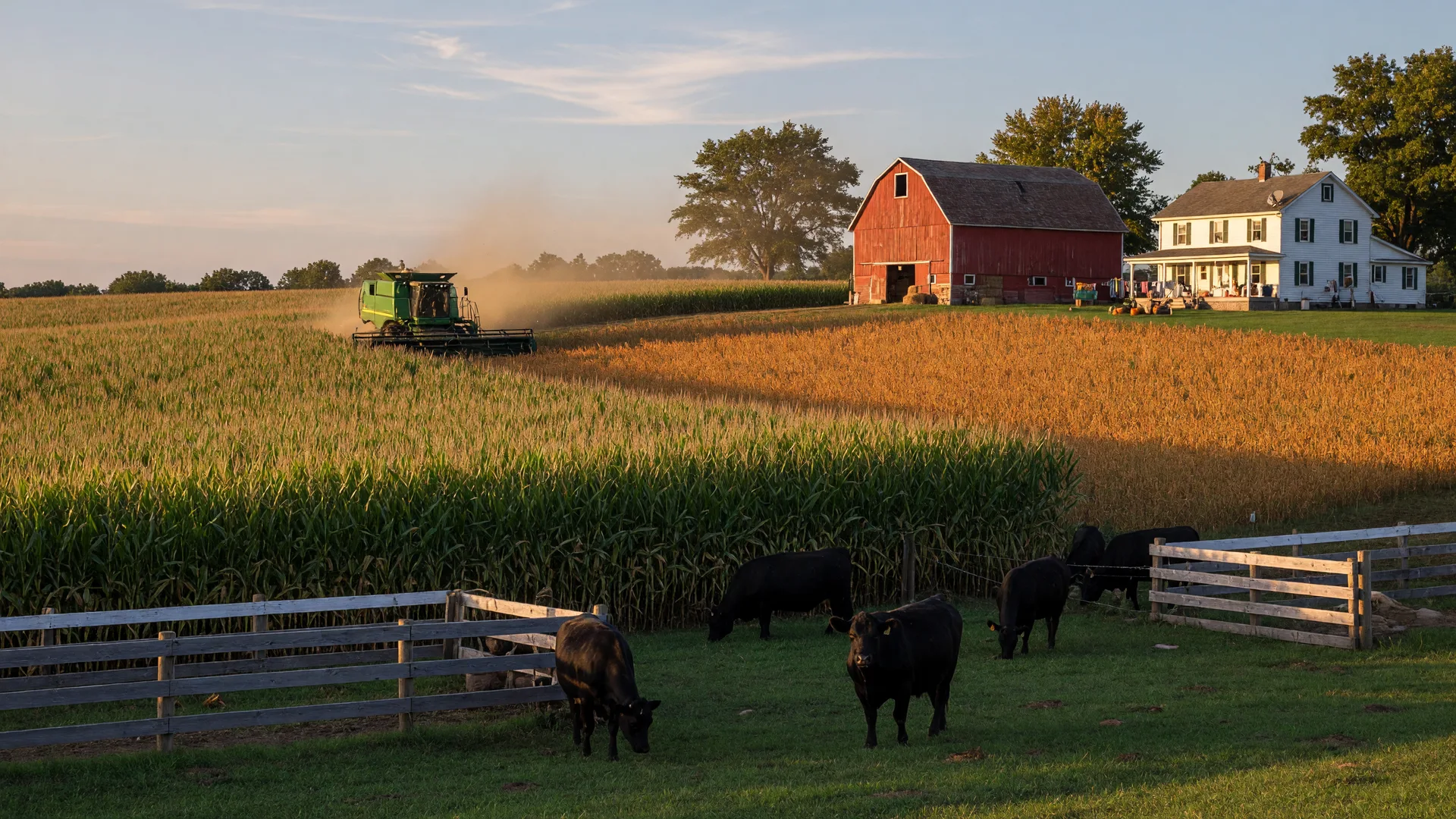
U.S. markets were closed Monday, September 7 for Labor Day, so Friday's close is the number in the books as we head into the September WASDE on the 11th. It was a fade into the long weekend: grains settled lower on profit-taking after a run to contract and multi-year highs, cattle finished the week lower on thin cash, and wheat gave back the most as Black Sea headline risk rolled over. Here is the straight talk on Friday's close and the look ahead over the next 48 hours when trading reopens Tuesday.
Cattle
Fri Sep 4 close: Oct live cattle $212.95/cwt, down $1.35. Oct feeder $320.15/cwt, down 95¢
What Happened
CME cattle futures and hog futures both closed lower on the week into the Labor Day weekend. On Friday, September 4, October live cattle settled down $1.35 at $212.95 per hundredweight and October feeder cattle fell 95 cents to $320.15, erasing part of the bounce from Thursday when the complex rallied as grains slid. Cash trade stayed light all week. Nebraska and western Cornbelt live steers traded around $218 with dressed near $345 on Friday, and negotiated cash volumes ran well below the prior week. USDA put the five-area cattle volume at roughly 48,817 head Friday, with trade mostly inactive and demand light after the holiday pull-ahead.
Boxed beef was mixed Friday. The Choice cutout slipped 73 cents to $376.17 per hundredweight while Select added $5.15 to $355.87, which tightened the Choice to Select spread to about $20.30. Estimated fed cattle slaughter came in near 97,000 head for the day. The story that kept this market capped remains the same one from a week ago: packers hold the upper hand on a quiet cash market, and traders are still working off the import policy and border headlines even as the long-term tight-herd story stays intact.
The analyst read out of Drovers this week was cautious but not bearish for the long run. Market analyst Scott Varilek of Kooima Kooima & Varilek said the cattle market was very oversold and due for a bounce, though the long-term charts had taken some damage. That is about as honest a one-line summary as you will get: short term stretched and due a pop, big picture still traded with both hands until cash firmed up.
Next 48 Hours Outlook
Trading reopens Tuesday and the board will first have to absorb the long weekend, with processors and feeders alike working through pipeline inventory. Watch the cash market for the first post-holiday bids, and whether dressed trade can hold the upper $340s. If futures hold the oversold bounce the analysts are pointing at, October live cattle can work back toward $214 against the $212 support. The September 11 WASDE is a grain event first, but a bearish grain read removes pressure from feeding costs and gives cattle a little air. Keep an eye on boxed beef too; a firmer Choice cutout into the week is the quickest signal that packer demand is rebuilding.
Corn
Fri Sep 4 close: Dec contract $5.36 3/4/bu, down 4¢, pulling back from contract highs
What Happened
December corn settled Friday at $5.36 3/4 per bushel, down 4 cents, fading from the fresh contract highs it marked in the prior sessions around the $5.43 to $5.44 area. It was a pullback, not a breakdown. The market spent the week running into two-sided, choppy trade, with ADM Investor Services daily commentary reporting Dec corn pressing new contract highs early on before profit-taking and pre-report positioning knocked it back ahead of the holiday.
The bull case has not gone anywhere. The supply story is tight: crop conditions have slipped to season lows on a hot, dry stretch across much of the Corn Belt, and DTN yield models have flagged that corn and soybean yields are unlikely to climb above early-August forecasts heading into harvest. Strong old-crop export demand keeps flowing, with new-crop export commitments running far above a year ago, and corn-for-ethanol use has been steady near 15.5 million bushels a day. What capped the rally was profit-taking after a steep multi-week run, heavy South American export supply, and buyers stepping back ahead of the September 11 WASDE.
The trade is setting up for the report the old-timers call corn's big number. Pro Farmer's Crop Tour put the U.S. corn crop at 15.344 billion bushels at 173.2 bushels an acre, well under USDA's current 180.7, and the Street is braced for USDA to trim. That expectation is part of why corn spent late August and early September trading so firm.
Next 48 Hours Outlook
Corn reopens Tuesday in the shadow of a report that does not drop until the 11th, so look for consolidation first. Support sits right in the $5.34 to $5.36 zone, and a firm hold there keeps the bias to buy dips ahead of the WASDE. The weekly export sales report Thursday is the other driver, and a strong print keeps the demand story honest. The risk is more hedge pressure as harvest picks up in the drier southwest Corn Belt, where heat has corn moisture coming down roughly a point a day. If USDA confirms a supply cut on the 11th, the market has talked about a run toward $5.50 and beyond; until then it trades the range-fade and the wait.
Soybeans
Fri Sep 4 close: Nov contract $13.09 3/4/bu, down 6 1/2¢, just off multi-year highs
What Happened
November soybeans settled Friday at $13.09 3/4 per bushel, down 6 1/2 cents, settling just below the multi-year highs it has been probing since late August. It was the same story as corn, profit-taking off a hot run with the bid underneath still intact. The beans have spent two weeks trading in the low to mid teens, their highest level for a November contract in years, on a combination of relentless demand and a weather-dented supply story.
The demand side is real and it is coming from China. USDA private exporters reported a flash sale of 192,000 metric tons of soybeans to China on September 3 for the 2026/27 marketing year, part of a steady string of Chinese purchases through late August when another flash sale moved 712,000 tons. On the supply side, soybean crop conditions had slipped to around 58% good to excellent against 65% a year earlier under the late-season heat and dryness in the southern Corn Belt. Pro Farmer's tour pegged the U.S. soybean crop at a record-potential 4.572 billion bushels at 53.3 bushels an acre, an outlook that has traders watching the WASDE for a yield surprise either direction.
ADM commentary this week put soybean resistance around $13.60, meaning the market has headroom before the overhead sellers show up. The fade Friday was about monetizing a four-day run before a holiday, not about demand cracking.
Next 48 Hours Outlook
Beans reopen with the $13.00 area as the line in the sand. A firm hold over the next two sessions and the market can press back toward $13.40 plus resistance before the WASDE. Watch for another USDA flash sale to China, which would light the board up in a hurry, and keep an eye on the weekly export sales report Thursday for confirmation that Chinese loading is still running hot. On the weather side, continued heat in the final fill stretch keeps a weather premium in the price right up to harvest. The September 11 report is the event the soybean trade has been feeding ever since the crop tours, and everyone is positioned for a tweak either way. Expect two-way chop until it drops.
Wheat
Fri Sep 4 close: Dec SRW contract $7.34 1/2/bu, down 20 1/4¢, off roughly 50¢ on the week
What Happened
Wheat was the biggest loser on Friday and on the week. December soft red winter wheat settled down 20 1/4 cents at $7.34 per bushel, and gave back roughly 50 cents on the week as traders cashed in the Black Sea risk premium that had built through late August. The roundtripper is a reminder that wheat is a headline market first and a fundamentals market second, and the headlines cooled.
The bull story is still real underneath. Ukrainian exports remain badly disrupted, with data pointing to a sharp year-over-year drop in August shipments, and EU officials are scrambling for alternative rail and river routes as Russian attacks and low Danube water squeeze wartime flows. But three things capped the rally this week. Turkey's foreign minister said Ankara has prepared a new mechanism to restore Black Sea grain exports and is negotiating it with both sides, a headline the market read as corridor risk easing. Russia has suspended its floating export duties on wheat, barley, and corn through the end of 2026, a signal that Russian supply will keep moving. And a transit dispute where Moldova's state railway halted grain transfers at the Kuchurgan crossing, Ukraine's only rail grain exit to Moldova, took Ukrainian export momentum out in real time.
Pro Farmer's "Ahead of the Open" framed the week as consolidative, with grains holding key support and uptrends intact ahead of the September 11 WASDE. That fits wheat as well as corn and beans, but wheat needs a fresh Black Sea headline to find its next leg higher. Without one, it works off the premium.
Next 48 Hours Outlook
Wheat reopens Tuesday as the most headline-sensitive market in the complex. A firm world bid and any word that the corridor talks stalled would put the Black Sea premium right back in. Any movement toward a deal, or a reopened corridor, takes air out fast. The weekly export sales report Thursday will show whether world buyers have shifted purchases to U.S. wheat to hedge the uncertainty; a strong print is friendly. Support down around $7.30 and a clean hold there keeps the chart intact, but expect real two-way volatility. Treat sharp breaks as news-driven, not a trend change, until the WASDE and the next Black Sea headline sort themselves out.
What This Means for
The Bottom Line
The grains rolled into the Labor Day weekend lower on profit-taking after a run to contract and multi-year highs, but the underlying stories are intact: a tight corn and bean supply picture heading into the September WASDE, relentless Chinese export demand, and a wheat market that gave back premium but not its fundamental headache. Cattle closed lower on thin cash even as analysts call it oversold. For Wisconsin farm and land sellers, the grain signals are still running in your favor in the front half of the fall window, and the report on the 11th is the next thing worth watching.
I watch these markets every day because they tell me what the buyers I work with are thinking. If you want an honest read on what your farm or land is worth in this market, give me a call. I will walk your ground with you and tell you straight what I see.
Read More on the Site
This update lives under our Cattle and Cash Crops section, where you can find deeper guides on cattle property, crop land, and what Wisconsin rural land is really worth.